Description
The line is the music
From my earliest days as a guitarist I have been a fan of acoustic guitars and John McLaughlin. When he released the first batch of Indian influenced acoustic LPs with Shakti in the 1970’s, it immediately spoke to me. With my rather limited technique I tried to improvise in that style. Over the years I collected various transcriptions of Shakti material, some done by friends some by myself. Obviously I was never able to play these along with the records, but they made excellent practice.
Fast forward to the Summer of 2015, when my wife dragged the family to a conference of improvised music in Switzerland. This was not improvised music as in Jazz, but improvising with a bunch of people with little or no agreed upon parameters. Often more rewarding for the players than the listeners. One of the evening concerts was by a trio which included Swiss guitarist Christy Doran. This guy had been an early influence on me even before John McLaughlin – and I had all but forgotten. After returning to the US I checked out his music on the web. While their set at the conference didn’t resonate as much with me, Christy’s own contemporary recordings really impressed me and I could easily see the connection to the band I originally heard him with in the 1970s, OM.
After years of emphasizing classical style fingerpicking I started again playing more with a pick. Naturally the Shakti transcriptions bubbled up from under the pile of music. My writing changed (evolved?) and some pretty interesting tunes were composed and made it into my band’s book. Then, in October 2015, as I was improvising in a ‘shakti-style’, it occurred to me that I should write some of these ideas down. Which was not that easy, because most of it was not in constant meters and a stream of melodic material. As with most of my projects, noticing that a chunk of musical material has potential to become part of something and determining what that something could be is the biggest creative step. I had probably 15 different small musical ideas from which I could evolve longer pieces. I decided I was going to write ten pieces total, each about three pages. You need some parameters, right? This is usually the point at which a project goes from just being a personal exercise to something that might get published in some form.
Some musical notes here:
– I wrote these to be played with a flat pick but that doesn’t mean fingerpickers are excluded.
– These pieces are really modal, some change ‘keys’, one uses a ‘synthetic’ key signature (which is really just a D-minor melodic). Functional harmony or chord changes were not involved.
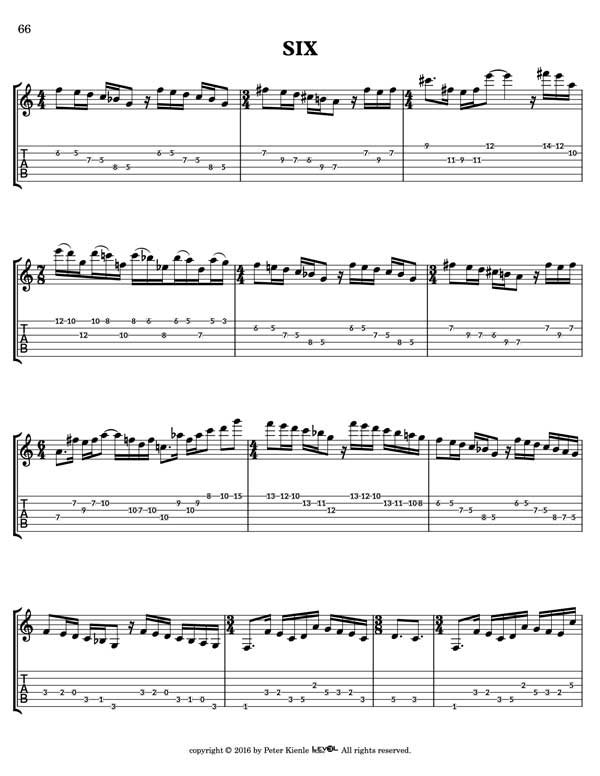
– The meat of the material is the stream of notes. This rather dense flow makes the melody and at the same time provides the harmonic environment. Some of the pieces have rhythmic chordal sequences which set up a mood or establish a modality. But there is no need (or space) to play a bass line or chords behind the melodic lines.
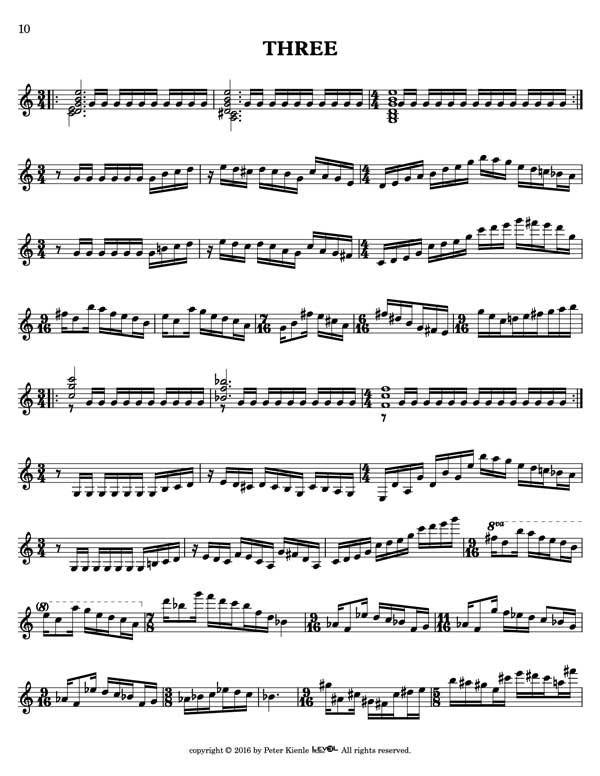
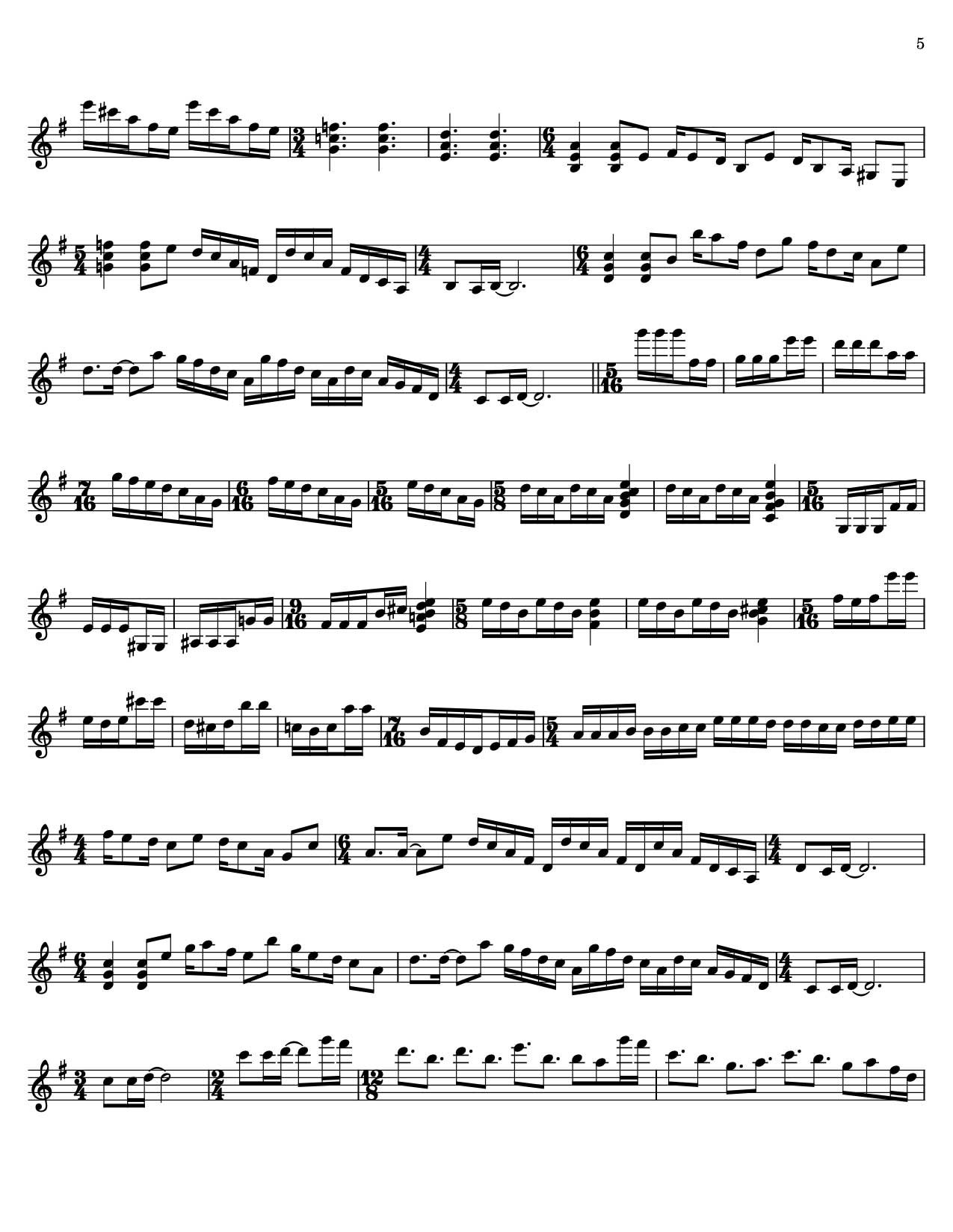
– As mentioned above, these exercises were written while improvising over melodic ideas and patterns while not paying attention to any regular time signature. That was fine on manuscript paper but notation software wants time signatures (even if you can hide them). That’s how the really odd and unintuitive 11/16, 21/8 etc., come about. Some spots work just fine in a 3/4 or 4/4 context for a few measures and you can actually count them like normal music. But for many of the strange passages I thought about dropping time signatures and just use dotted bar lines for structuring. After talking to some knowledgable friends they recommended to leave all time signatures in. So there.
– The main patterns I ended up with (apart from regular meter stuff) are compounds of 2, 3 and 4 sixteenths, grouped into larger rhythmic groups. If you need to tap your foot, the beginning of a grouping is a good spot. One of the main things to keep in mind is that ALL 16ths in a given piece are of the same length. Sometimes, when a piece goes from groupings of two or four to three 16ths it might look like going to triplets – nope! The 16ths stay the same – except for the few spots where there are explicitly 16th triplets.
– Many chord voicings here are written with three notes only but are played on the A, D, G strings with the open B and E strings droning along. Often this is explained at the given spot in the piece. But, again, beautiful chord progressions and advanced voice leading was not the goal.
Have fun with it.
(Peter Kienle 4/22/2016 & revised version 8/14/2025)