Description
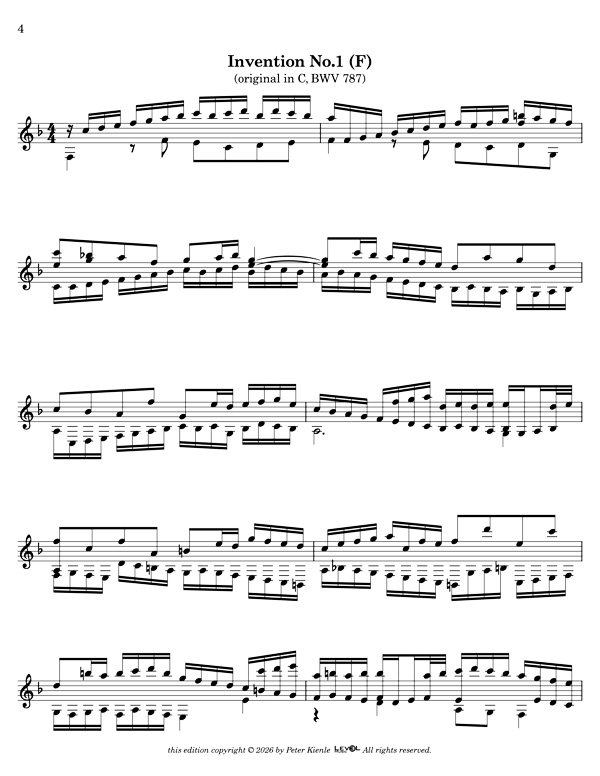
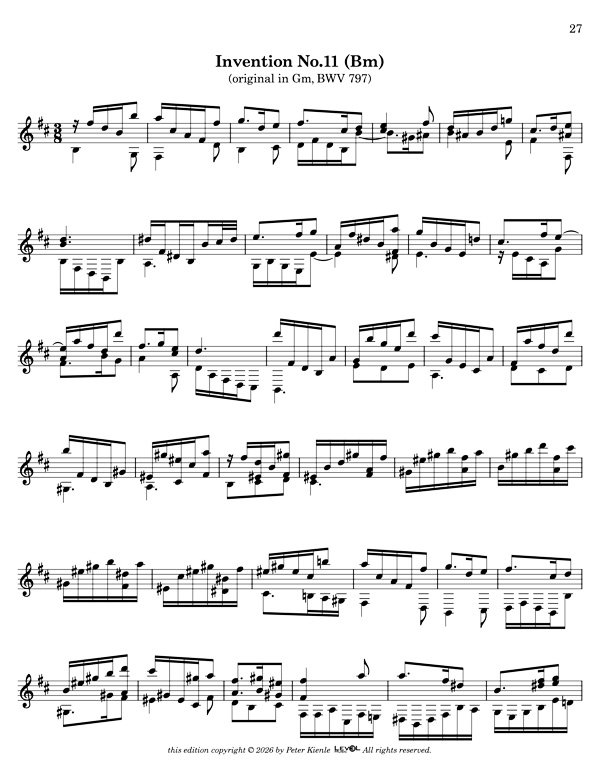
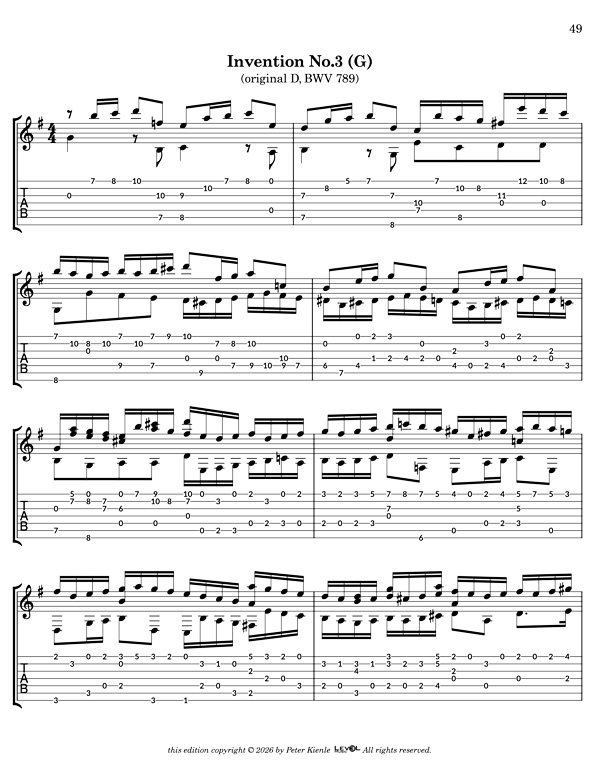
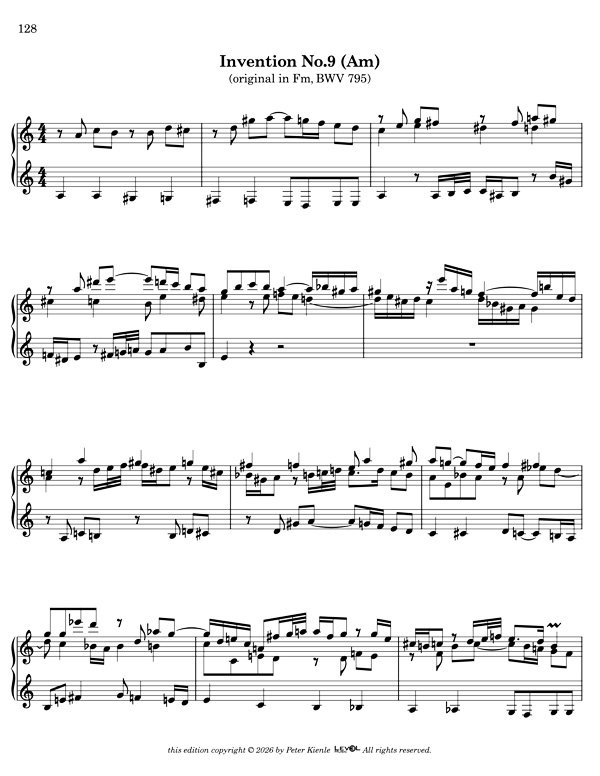
Standard, TAB & grand staff, 154 pages
click for preview of full book
table of contents:
Invention 1 in F (BMV 787)
Invention 2 in F#m (BMV 788)
Invention 3 in G (BMV 789)
Invention 4 in Am (BMV 790)
Invention 5 in A (BMV 791)
Invention 6 in Bb (BMV 792)
Invention 6 in A (BMV 792)
Invention 7 in Am (BMV 793)
Invention 8 in A (BMV 794)
Invention 9 in Am (BMV 795)
Invention 10 in C (BMV 796)
Invention 11 in Bm (BMV 797)
Invention 12 in E (BMV 798)
Invention 12 in D (BMV 798)
Invention 13 in Dm (BMV 799)
Invention 14 in F (BMV 800)
Invention 15 in Em (BMV 801)
last revision 2026-8-26
When I bought my first seven string guitar a few years ago, I was expecting it to be a smooth graduation from six to seven strings. It took a few weeks to become able to actually just ignore that extra string and play regular six string guitar music. Slowly I started incorporating some of the lower notes, but for a long time it felt more like 6+1 strings. Jazz shell voicings were the next big step. Walking bass lines. Reading cello music at least gave some workout for that extra low string. But somehow I couldn’t find much music specifically written for seven string guitar – music that requires that low B string.
Eventually I realized that the extended range offered an opportunity to finally come up with playable versions of some of my favorite collections of classical music. The transcriptions in this volume are transposed versions of Bach’s originals. Having several independent parts going on simultaneously provides great opportunities to explore the fingerboard. If you improvise solo jazz guitar – melody, chords, bass lines – this is especially wholesome exercise in voice independence. Some pieces do require work past the 12th position on the seventh string.
In Bach’s original work the trills, mordents and other ornamentations figure prominently. I found them close to impossible to execute cleanly on the guitar so removed them (they are in the grand staff version).
I never liked to deal with guitar TAB unless absolutely necessary. On these pieces though, when I tried to decide how much fingering information should be written in, I noticed that the right amount would have really cluttered up the standard notation. It seemed better to just add a TAB staff and provide two versions: one in just standard notation, the other with standard and TAB notations. My suggested fingerings are however only that. The third section of this issue consists of grand staff versions with both staves in treble clef. Except for the transpositions, this preserves the presentation of the piano version.